
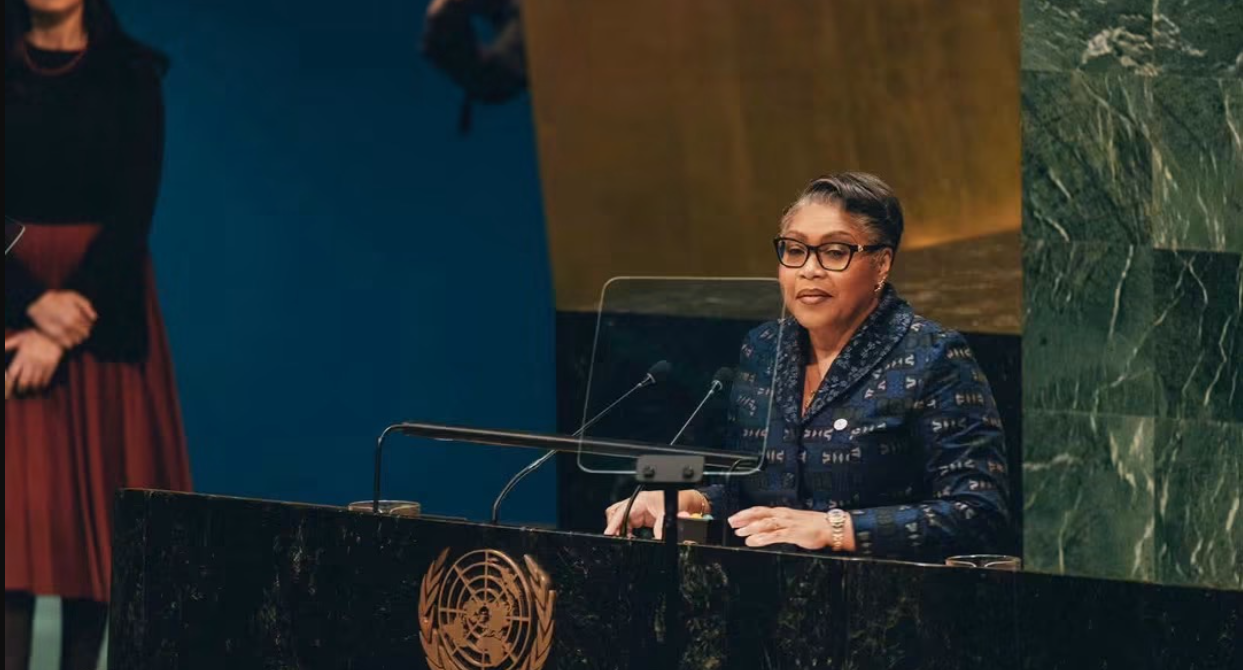
The security situation in the East of the Democratic Republic of the Congo was central to Prime Minister Judith Suminwa Tuluka's speech on September 23, 2026, at the general debate of the 81st session of the United Nations General Assembly in New York.
Speaking on behalf of the DRC in the name of the President of the Republic, Félix-Antoine Tshisekedi Tshilombo, the head of the Government expressed Kinshasa's concerns about the persistence of violence, while reaffirming the importance of diplomatic channels, sovereignty, and the effective implementation of international commitments in favor of peace.
For several decades, the populations of Eastern DRC have faced violence leading to significant displacements, loss of life, and severe humanitarian consequences. In her speech, Judith Suminwa emphasized the need for an international response to sustainably address this situation.
The issue of the FDLR at the heart of the security debate
The Prime Minister specifically addressed the issue of the Democratic Forces for the Liberation of Rwanda (FDLR), which is frequently mentioned in the context of the regional security crisis.
She reported on the progress made in the disarmament and demobilization process of the movement, following the protocol signed on May 30, 2026, by its political and military leadership. This arrangement notably provides for the encampment of the concerned combatants, with a view to their repatriation or relocation, without prejudice to possible legal proceedings against the perpetrators of serious crimes.
Judith Suminwa also mentioned the repatriation, on September 8th, of 120 people associated with the FDLR with the support of MONUSCO, presented as a concrete translation of this process.
For Kinshasa, these advances must be taken into account in assessing the regional security situation. The Prime Minister thus considered that the issue of the FDLR could no longer serve as justification for maintaining a foreign military presence on Congolese territory.
Peace mechanisms to coordinate
In her speech, the head of the Government also emphasized the need for better coordination among the various diplomatic frameworks involved in seeking a solution to the crisis.
The Washington and Doha processes, along with the African Union initiatives, have been presented as complementary frameworks aimed at achieving concrete progress.
The DRC particularly wishes that their implementation is based on a precise schedule, independent verification mechanisms, regular information sharing, and effective consequences in case of violation of commitments.
This position is in line with the decisions already adopted by the United Nations Security Council, notably resolution 2773, adopted on February 21, 2025. It notably calls for the cessation of hostilities, the withdrawal of Rwandan forces from Congolese territory, the end of support for armed groups and the disengagement of the AFC/M23, as well as the restoration of state authority in the affected areas.
In a message published after her speech, Judith Suminwa summarized the position held by the DRC in these terms: the priority is now to move from commitments to concrete actions.
MONUSCO urged to continue its role with the populations
Judith Suminwa also emphasized the role of the United Nations Organization Stabilization Mission in the Democratic Republic of the Congo (MONUSCO) in protecting civilians, monitoring the ceasefire, and supporting agreed mechanisms.
While the future of the Mission's presence is under discussion, Kinshasa believes that any development must take into account the security conditions on the ground, the gradual strengthening of national capacities, and the need to ensure that no security vacuum is created to the detriment of the civilian population.
Sovereignty and economic partnership
Beyond the security issue, the Prime Minister also defended the DRC's place in the global economy.
She expressed the ambition to see the country evolve as a sovereign partner in the global economy, rather than just a supplier of resources. This message aligns with Kinshasa's stated intention to further enhance the country's resources and strengthen its position in international trade.
Judith Suminwa also advocated for better representation of Africa on the United Nations Security Council, as part of discussions on reforming the multilateral architecture.
Kinshasa reaffirms its own commitments
Beyond the appeals made to the international community, the Prime Minister also presented the DRC's commitments in the process of stabilizing the country.
The Government intends to continue reforms in the defense and security sectors, strengthen the authority of the State, and contribute to the reconstruction of territories affected by conflicts.
At the United Nations podium, Judith Suminwa reaffirmed the DRC's commitment to the diplomatic path, respect for its sovereignty and territorial integrity, as well as the effective implementation of international decisions and commitments.
For Kinshasa, the challenge now is to concretely translate these commitments on the ground, in order to strengthen the protection of the populations and promote the sustainable return of peace and stability in the East of the Democratic Republic of the Congo.