
The relations between the Democratic Republic of the Congo (DRC) and Angola began in 1975, at Angola's independence, marked by tensions and conflicts, they have improved and normalized. Angola has played a key role in stabilizing the DRC. Since then, the two countries have strengthened their cooperation, evolving towards a constructive friendship and strategic partnership, particularly in the face of security challenges in the East of the DRC.
Meeting between the two Heads of State
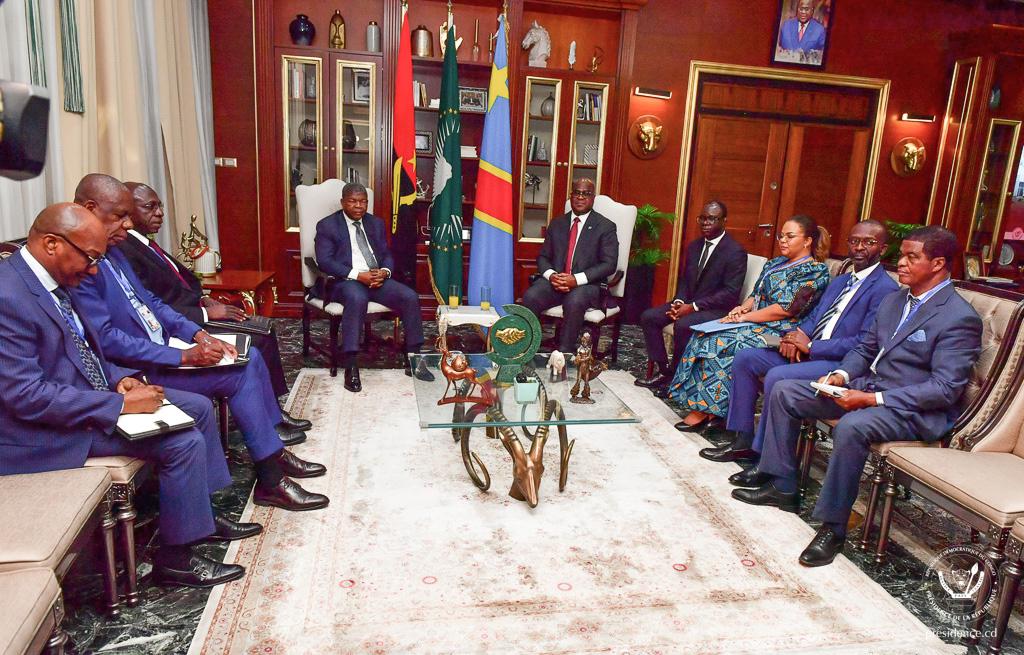
It was on Monday at the African Union City that President Félix Tshisekedi had a 40-minute one-on-one with his Angolan counterpart João Lourenço, the African Union mediator for the return of peace in the East of the Democratic Republic of Congo (DRC), during a working visit to Kinshasa. The Luanda Process as well as the ceasefire decided by the DRC and Rwanda during the ministerial meeting on July 30th were at the center of their discussions.
À l'issue de cette rencontre, les deux Chefs d'État ont présidé une séance de travail élargie à leurs proches collaborateurs, avant l'animation d'un point de presse conjoint par les ministres des Affaires étrangères des deux pays. Mme Thérèse Kayikwamba, ministre des Affaires étrangères de la RDC, a déclaré : "Les Présidents Félix Tshisekedi et João Lourenço ont salué l'entrée en vigueur du cessez-le-feu le 4 août dernier et ont exprimé leur attachement ferme à ce que cela soit respecté. [1]
Commitment of the Congolese government and the ceasefire verification mechanism
President Félix Tshisekedi reiterated the full readiness of the Congolese government to participate in all upcoming stages of the Luanda Process under the auspices of mediator João Lourenço. According to the Congolese Minister of Foreign Affairs, "we are in an encouraging dynamic where the ceasefire is largely observed ."We maintain this positive momentum because we reiterate that the ceasefire will create the favorable conditions for us to address the underlying issues.
En ce qui concerne le monitoring de ce cessez-le-feu, le ministre angolais des Affaires étrangères, António, a précisé qu'il y a un mécanisme de vérification ad hoc mis en place et qui sera renforcé pour qu'il soit mieux outillé afin de remplir correctement sa mission. [2]
Angola's Mediation Efforts
Angola plays a crucial role in mediating between the DRC and Rwanda to resolve the crisis in the eastern part of the country. President João Lourenço has been appointed by the African Union as a mediator to address the issue of relations between the two countries. During an official visit to Côte d'Ivoire in June 2024, the Angolan President stated that negotiations were underway to soon organize a meeting between Rwandan President Paul Kagame and his Congolese counterpart Félix Tshisekedi, in order to achieve lasting peace in the eastern DRC.
We are negotiating at the ministerial level, with the aim of very soon bringing together the two heads of state of the DRC and Rwanda, for a direct exchange on the inalienable need to achieve definitive peace", revealed João Lourenço. He emphasized that "the only solution is, without a doubt, to try to resolve this conflict around a negotiation table.[3]
International Support
La communauté internationale soutient activement les efforts de médiation de l'Angola dans la crise entre la République Démocratique du Congo (RDC) et le Rwanda. En juin 2024, le Président français Emmanuel Macron a exprimé son appui au Président angolais João Lourenço, soulignant l'importance d'une solution négociée pour résoudre les tensions dans la région des Grands Lacs. [4]
Similarly, the United Kingdom has expressed its commitment to assist the DRC, as stated by Lord Benyon during his meeting with Congolese President Félix Tshisekedi in July 2024. These initiatives come in a context of security deterioration in the East of the DRC, particularly in the North Kivu province, where armed groups, including the M23 supported by Rwanda, have been exacerbating violence for decades.
Context of the security crisis in DRC
The security situation in the East of the DRC is marked by persistent conflicts between various armed groups, both local and foreign, exploiting the region's natural resources. The M23, a rebel group, has recently taken control of vast territories, almost completely encircling Goma, the provincial capital. This offensive has led to a massive influx of displaced people, further worsening an already severe humanitarian crisis. The DRC accuses Rwanda of supporting the M23 in its attempts to seize the mineral resources of the East, an allegation that Rwanda denies, arguing that it is defending the rights of a threatened minority in the region.[5]
In conclusion, the mediation efforts led by Angola, under the auspices of the African Union, seem to be bearing fruit with the implementation of a ceasefire between the DRC and Rwanda on August 4th. President Félix Tshisekedi and his Angolan counterpart João Lourenço call for strict adherence to this ceasefire, which should create favorable conditions to address the underlying issues.


